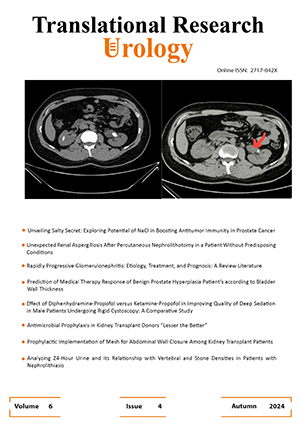
Analyzing 24-Hour Urine and its Relationship with Vertebral and Stone Densities in Patients with Nephrolithiasis
نویسندگان
1 Health Policy Research Center, Institute of Health, Shiraz University of Medical Science, Shiraz, Iran
2 Department Radiology and Interventional Radiology, Imam Khomeini Hospital and Shariati Hospital, Tehran University of Medical Sciences, Tehran, Iran
3 Urology Department, Shariati Hospital, Tehran University of Medical Sciences, Tehran, Iran
4 Surgery Department, Valiasr Hospital, Shiraz University of Medical Science, Shiraz, Iran
5 Urology Department, Shariati Hospital, Tehran University of Medical Sciences, Tehran, Iran
6 Urology Department, Shariati Hospital, Tehran University of Medical Sciences, Tehran, Iran
doi
10.22034/tru.2024.494254.1208چکیده
Introduction: Urolithiasis, or kidney stone formation, is a prevalent condition that affects a significant portion of the population, with calcium-based stones being the most common type. The relationship between kidney stones and bone health remains an area of active investigation, as mineral metabolism disturbances may contribute to bone loss and kidney stone formation. This study analyzed the relationship between 24-hour urine and blood electrolyte levels, vertebral bone density (BMD), and kidney stone density in patients with nephrolithiasis.Methods: We conducted a single-center, cross-sectional study involving 50 patients diagnosed with urolithiasis who underwent percutaneous nephrolithotomy (PNL) at Shariati Hospital from 2015 to 2021. Statistical analyses were performed using SPSS version 22, with a P-value<0.05 considered significant.Results: Our study found a significant positive correlation between 24-hour urine calcium levels, kidney stone density, and vertebral BMD. However, no significant association between kidney stone density and vertebral BMD was observed. Additionally, patients with diabetes, osteoporosis, and those using bisphosphonates or vitamin D showed notable variations in vertebral density.Conclusion: Our findings emphasize calcium metabolism's critical role in kidney stone formation and bone health. We suggest a need for a multidisciplinary approach to managing urolithiasis, particularly for patients with concurrent low bone mineral density (BMD). Further studies are required to improve personalized treatment strategies, with more emphasis on lifestyle factors and long-term monitoring of patients with both conditions.