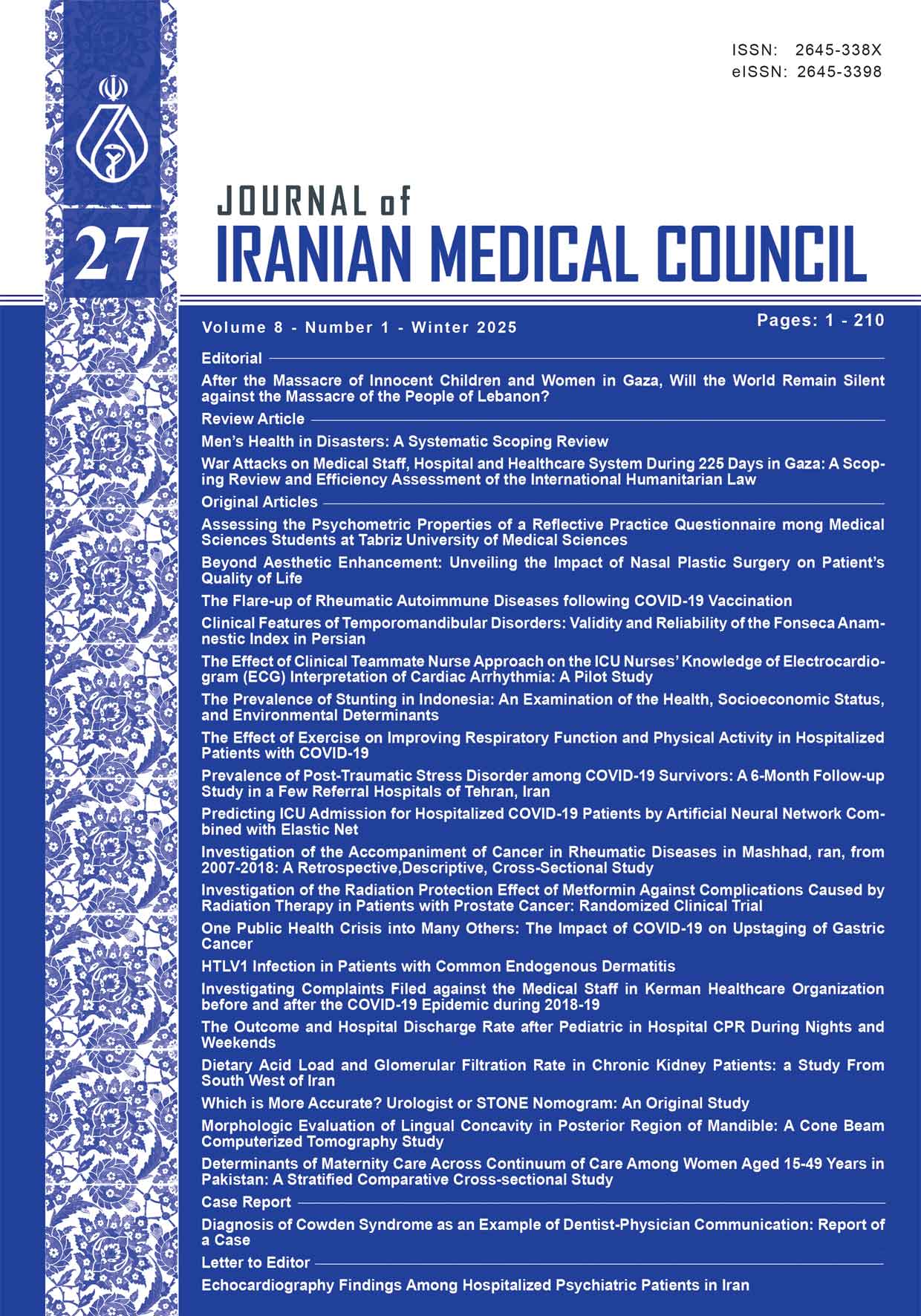
Clinical Features of Temporomandibular Disorders: Validity and Reliability of the Fonseca Anamnestic Index in Persian
نویسندگان
1 Department of Oral Medicine, School of Dentistry, Shahid Beheshti University of Medical Sciences, Tehran, Iran
2 Department of Oral and Maxillofacial, School of Dentistry, Shahid Beheshti University of Medical Sciences, Tehran, Iran
3 Private Practice,Tehran,Iran
4 Department of Oral Medicine, School of Dentistry, Shahid Beheshti University of Medical Sciences, Tehran, Iran
5 Department of Prosthodontics, School of Dentistry, Shahid Beheshti University of Medical Sciences, Tehran, Iran
6 Department of Prosthodontics, School of Dentistry, Shahid Beheshti University of Medical Sciences, Tehran, Iran.
7 Department of Oral Medicine, School of Dentistry, Guilan University of Medical Sciences, Rasht, Iran
doi
http://dx.doi.org/10.18502/jimc.v8i1.17060چکیده
Background: Temporomandibular Disorders (TMDs) are a group of disorders associated with masticatory dysfunction. TMDs are usually diagnosed late which leads to complicated treatments. Early diagnosis and treatment of TMDs are essential.Methods: A valid and reliable version of Fonseca’s Anamnestic Index (FAI) was prepared in Persian from the English version. It was used to assess TMD in 350 patients. Clinical signs of TMD were also recorded based on examination.Results: FAI scores showed 161(46%) people had TMD. There was no significant difference between occlusion classes in terms of the frequency of TMD. There was no significant difference between the mean maximum mouth opening and severity of TMD.Conclusion: In this study the validity and reliability of the FAI in Persian language, as a simple tool for TMD screening in health centers, was confirmed. Based on results, there is a relationship between clinical findings and the severity of TMD by using FAI and it can be used for screening TMD patients.