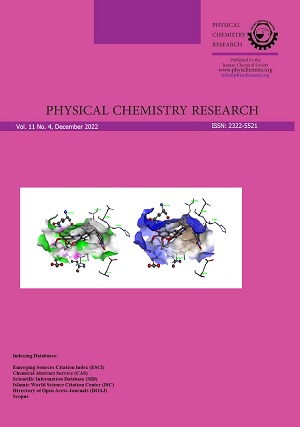
Thermodynamic Insights into Vanillin Partition in 1-Decyl-3-Methyl Imidazolium Chloride and Potassium Phosphate Salts Aqueous Two-Phase Systems at (298.15 to 313.15) K
نویسندگان
1 Faculty of Chemical Engineering, Babol University of Technology, Babol, Iran
2 Faculty of Chemical Engineering, Babol University of Technology, 47148-73113, Babol, Iran
3 Chemical Engineering Department, Faculty of Engineering, Shomal University, 46161-84596, Amol, Iran
doi
10.22036/pcr.2025.472769.2564چکیده
The present study investigated the thermodynamic aspects of vanillin partition in an aqueous two-phase system (ATPS) formed by 1-decyl-3-methyl imidazolium chloride ([Dmim]Cl) + dipotassium hydrogen phosphate (K2HPO4) or tripotassium phosphate (K3PO4) at different temperatures (298.15, 303.15, 308.15 and 313.15 K). The phase diagram and liquid-liquid equilibrium (LLE) data were determined experimentally and fitted with the innovative HIS-UNIQUAC model. Furthermore, the influence of temperature on the binodal curve, tie-line length (TLL), and slope of tie-line (STL) are discussed for both salts. In addition, the tie-line data were fitted by Setschenow-type equation and effect of temperature and hydration ability of anions on the phase separation ability were studied. The studied ionic liquid/salt ATPS were investigated for the impact of variables such as temperature, pH, and tie-line length on the vanillin's partitioning coefficient, extraction efficiency, and thermodynamic properties of the transfer process including the standard molar enthalpy and entropy of transfer (∆_tr H_m^0 ,∆_tr S_m^0). The Results indicate that vanillin is preferentially extracted in the ionic liquid-rich phase at lower temperatures and at lower pH medium with the partition coefficients up to 227.07 and recoveries up to 98.7% attained in a single step.